Alien Brains

When you imagine an alien, what do you see? Do you see a little green person with big black eyes and an enormous bulging brain? Does its brain think like ours and work like ours? 

The fact is, an alien’s brain would look completely different to ours, and work in a totally different way. 

How did you work that one out? Ed

Our brains work the way they do because we have been evolving under Earth conditions for hundreds of millions of years. We live in an oxygen-rich environment, so we run on an energy system that requires it. We have lungs and oxygenated blood vessels weaving through our neurons to keep them alive. The average surface temperature of our planet is a very pleasant 15 degrees, within a small range of temperatures at which water is almost always liquid. That’s why our brains are mostly like big, sloshy water bags.

OK, I’m with you so far…

But the universe offers an infinite array of environmental conditions under which life could evolve. That means it could produce alien intelligence that is barely recognisable to us, or our little green imaginary alien friends.

So, how do these aliens think?

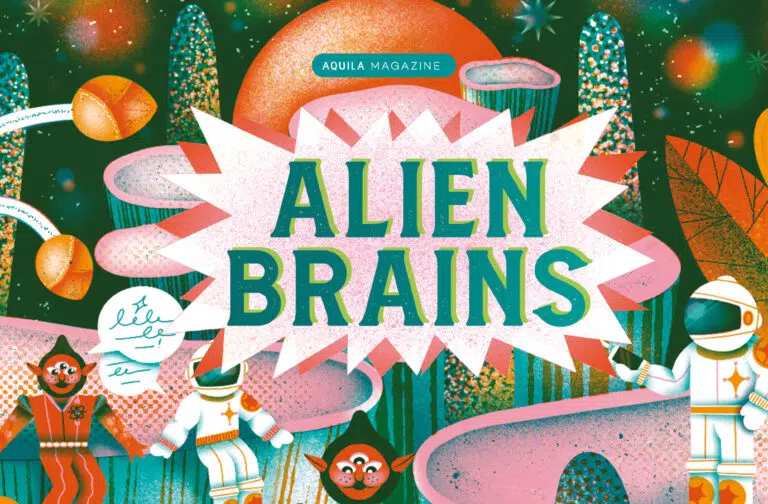
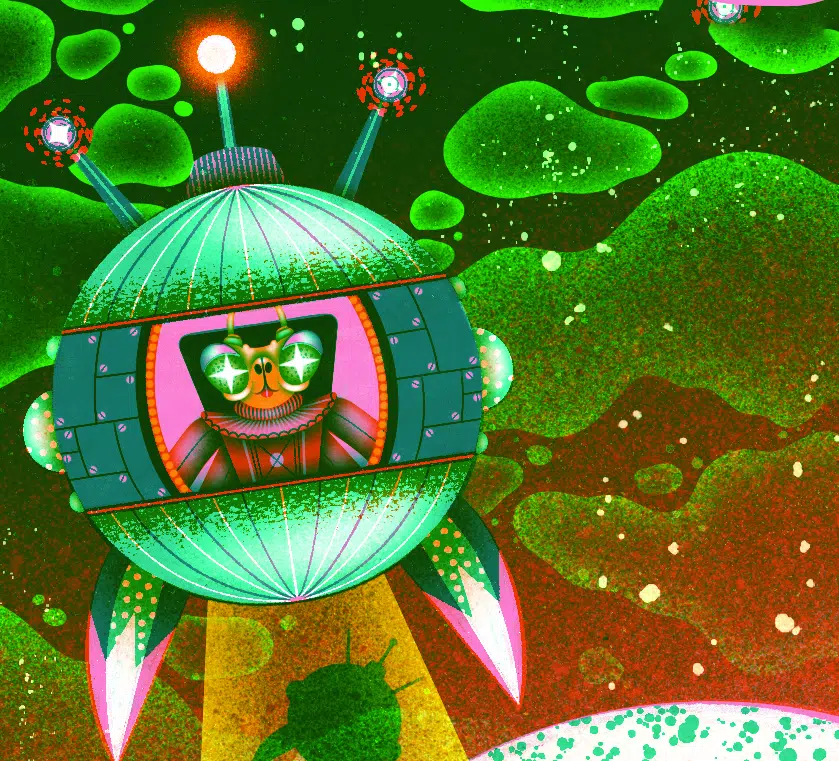
Illustration by Jasmine Floyd

A hot planet brain

Let’s say this alien planet is much closer to its host star, so they get a lot more light and live on a hotter planet. Liquid water would not be possible here, but liquid aluminium might be. This is made more possible because planets closer to their host star tend to be richer in heavy elements, such as aluminium. The lighter stuff gets pushed out to the outer rims of the solar system (Jupiter, Uranus and Neptune are mostly made up of lightweight helium and hydrogen).

Closer to a star means more energy! All the energy we use in our brains ultimately comes from plants, which convert sunlight into food. Planets closer to their host star could have a biological environment and food chain that involves a lot more energy. So, these alien brains might work with a lot more oomph. The US National Library of Medicine states that our brains work with about 12 watts of energy, this is around the needs of a Nintendo Switch! If an alien had a lot more energy to work with, then it could work much faster, sending electrical impulses through the aluminium liquid itself, instead of a long link of neurons.

That’s alarming. Do we want to meet aliens that are much cleverer than us?

Oh that’s nothing. If the metal was not aluminium, but something like iron, then it could be magnetised. If this was the case, then maybe the body could be controlled directly from the brain via electromagnetism, instead of impulses being sent down nerves to muscles!

Illustration by Jasmine Floyd

An older civilisation

Life could have started on the alien planet much earlier than it did on Earth. An alien species might have had a few extra hundred million years to evolve. This would be the equivalent of comparing dinosaurs to us! We are much smarter than the average T-rex, so these aliens might have bigger, older, more sophisticated brains. 

You mean to say the human brain doesn’t represent the peak of evolution?

Absolutely not. Possible natural improvements could be the evolution of fibre optic neurons (like how the internet is delivered to your house/street). Bioluminescent (glowing) cells could transmit light down crystalline glass-like structures. If that was the case, cognition (thinking, learning, remembering, creating etc) would only be limited by the speed of light – meaning these aliens could think really, really quickly and complete their homework in a couple of seconds. We know both these bioluminescent and translucent cells exist on Earth in animals, so it is not that far-fetched to think that, given enough time, a brain like this could evolve.

Illustration by Jasmine Floyd

A social brain

Humans are particularly successful as a species because of our social structures. We form families, communities and countries that can build vast things visible from space. (Impressive, when you put it like that! Ed). An alien species might take this one step further, creating something science-fiction writers like to call a hive mind. Think of how a beehive is made up of thousands of tiny bees but behaves like one organism. How effective would mankind be if we all wanted and thought the exact same thing?

I don’t think I like the sound of that.

Me neither, but let’s go with it for the purpose of this thought experiment. If humans functioned like a hive mind, stimulation affecting one ‘sub-being’s’ brain could instantly be communicated to all the brains across the mega-organism. Taking this idea even further, a planetary-scale intelligence could exist, creating a vast, sentient cloud of interconnected entities all acting as one, stretching across continents or even entire worlds!

Whoa, I got a little carried away there, but the possibilities for alien intelligence are as limitless as the cosmos itself. Who knows what kinds of minds might be out there, waiting to be discovered?

If you enjoyed this incredible read, check out a subscription to AQUILA magazine

Words: Jacob Parrott. Illustration: Jasmine Floyd

Flying Saucer Automata

Flying Saucer Automata https://www.youtube.com/shorts/wX7H9WPjQao Words: The AQUILA team. Search Popular Keywords Categories No Record Found View All Results

Read More »