Can We Really Live on Mars? The Science of Terraforming

What are we going to do when we have finished messing up Earth, there are too many of us and we can’t all live here any more?
Some people have the idea that we could move to Mars, which you must have seen shining brightly in the south east sky all last month. But could we live on Mars? Well not right now – it’s too cold, there’s no water to make plants grow and no ozone layer to protect us from the Sun’s damaging ultra-violet rays. What could we do about this?

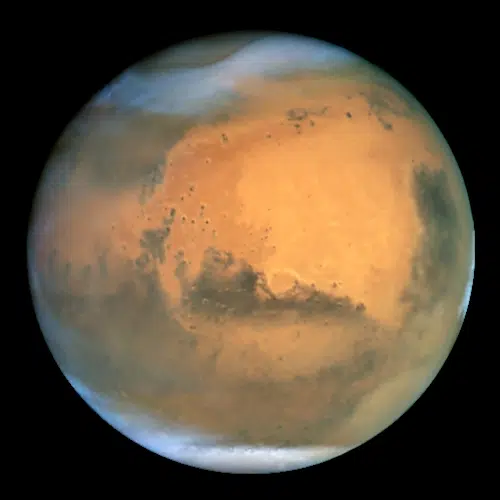
NASA’s Hubble Space Telescope took this picture of Mars, below, when it was 55,760,220 kilometres away, and just 11 hours before Mars made its closest approach to Earth in 60,000 years.

NASA and The Hubble Heritage Team (STScI/AURA), Public domain, via Wikimedia Commons

Terraforming

Terraforming means making an area suitable for Earth-like life forms to live there. So the idea is to change Mars into a planet where plants and animals from Earth could live.

Mars’ atmosphere is much thinner than Earth’s, so the pressure on Mars is much lower. If you were on Mars without any protection, you would pop! Mars is also much colder than Earth: the average temperature is -60° C. For Earth-like life to survive we need liquid water; the planet must not be too hot or too cold or we will only have steam or ice.

Habitable zones

Some stars, like the Sun, have a band around them called the habitable zone. This is where a planet with an atmosphere similar to Earth’s could possibly have liquid water. If the planet is too close to the star, then there will be too much sunlight, which will make the water break down into hydrogen and oxygen, and the light hydrogen disappears off into space, losing the liquid water.

The inner edge of the habitable zone is where there is simply too much light for liquid water to exist. A planet orbiting further from the star will be colder, but if it has an Earth-like atmosphere with greenhouse gases the planet can stay fairly warm due to the greenhouse effect. Past a certain point even this will no longer be enough to keep the planet warm. This is the outer edge of the habitable zone.

However this edge can be extended for certain types of planet. On Earth there is a lot of carbon dioxide tied up in the ground. When earthquakes and volcanoes occur, this carbon dioxide is exposed to the air. So on planets with a lot of carbon in the ground, and some way of recycling this carbon such as earthquakes and volcanoes, the outer edge of the habitable zone is further away.

Water on Mars

Mars is between these outer edges of the habitable zone. It has some carbon dioxide locked in its soil but will need some way of releasing it into the atmosphere. Mars also has water in ice form at its poles. But liquid water can exist only at the right pressure as well as the right temperature. So in order to get water on Mars we need to increase the pressure on the planet. This can be done by creating a thicker atmosphere. If the atmosphere contains greenhouse gases this will also warm up the planet by the greenhouse effect. On Mars there is a lot of frozen carbon dioxide. Carbon dioxide is a greenhouse gas. So if we warm up the planet slightly carbon dioxide gas will be released, which will create atmosphere and contribute to the greenhouse effect, thus warming up the planet more, so more carbon dioxide will be released, and so on.

Also, once the temperature gets high enough, the water on Mars (ice at the poles) will start to vaporise.

This will help increase the pressure and, as water vapour is also a greenhouse gas, it will also help to increase the temperature of the planet.

One way of creating an atmosphere is to artificially heat up the planet slightly. The ice caps at the poles reflect a lot of light and heat back into space. We could heat up the planet by somehow covering these ice caps, perhaps with dust. This would let the planet absorb the heat from the sun, so some of the water and carbon dioxide would vaporise, adding to the greenhouse effect.

Growing plants

These greenhouse gases won’t protect us from UV though. On Earth the ozone layer does this. Plants need protection from UV and so probably the first plants would be grown under glass in biomes. These are large glass structures similar to the ones at the Eden Project in Cornwall.

Once plants are established on Mars their green leaves will convert some of the carbon dioxide to oxygen, which animals can breathe.

And some of this oxygen will become ozone, giving the all important protection from UV, so we can eventually get rid of the biomes.

How soon?

With the technology we have now it will be at least 10,000 years before Earth-like animals can survive on Mars without any protective clothing or special environment. However, technological advances in the future may bring this date much closer.

Although it may be possible to terraform Mars, is it right? There may be life forms living under the surface of Mars that we have not found yet, and changing their environment could easily kill them.

Even if there is no life on Mars, is it right for Earth to simply take over this planet? Some say that we are not treating Earth properly – can we be trusted to look after Mars in the way we should?

Eden Project geodesic domes via Wiki Commons

If you enjoyed this XXXXXXX, check out a subscription to AQUILA magazine

Words: The AQUILA team.

Flying Saucer Automata

Flying Saucer Automata https://www.youtube.com/shorts/wX7H9WPjQao Words: The AQUILA team. Search Popular Keywords Categories No Record Found View All Results

Read More »