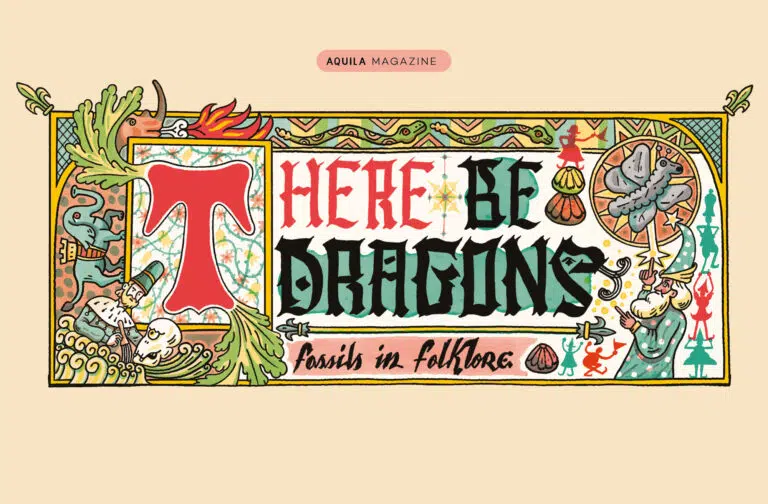
Fossils in Folklore

When Bones Become Legends

Imagine you are the very first human being on Earth to discover the fossilised remains of a prehistoric creature. What would you think you’d found? How would you describe your incredible discovery to other people? What stories would you and your friends create to explain these mysterious objects?

I reckon I’d think I’d found a dragon! Ed

And you wouldn’t be alone. Dragons appear in lots of different mythologies from around the world. One legend from the Austrian city of Klagenfurt tells of a dragon called a Lindworm, which terrorised and ate local people until it was defeated by a brave knight. In the 16th century, a sculptor used a previously discovered dragon’s skull as inspiration for a massive dragon statue. The statue is still in place, but the skull was eventually identified as the fossilised skull of an extinct woolly rhinoceros. 

So… not a dragon at all? Ed

Not a dragon. Sorry.

Let’s get this straight, right away. Are there any dragons? Ed

Well… Chinese medical textbooks from as early as the first century CE call for the use of dragon bones to cure many different illnesses, including insomnia and diarrhoea. 

So… dragons? Ed

Erm still no. It’s now widely believed that those dragon bones were the ground up fossils of dinosaurs and other prehistoric creatures. But dragons aren’t the only case of mistaken identity in this story. 

Woolly Rhinoceros (Coelodonta antiquitatis Blumenbach, 1807). Complete skull via Wiki Commons

Keeping one eye on the facts

Another famous mythological mystery from ancient Greece was a one-eyed giant called the cyclops. These fellas turn up in Homer’s Odyssey, the epic story of the warrior Odysseus’s journey home after the Trojan War. Tales of Cyclopes might have been inspired by the fossilised skulls of dwarf elephants, which can be found in some areas of Greece and Italy. These skulls  have holes in the centre – perfect  for one single,  enormous eye!

Alvin Padayachee, Public Domain, via Wikimedia Commons

Little wonders

It wasn’t just big bones that inspired these stories. Even the smallest fossils have their own stories in the places where they were found. Take ammonites, for example.

What are ammonon… anomon… what are they? Ed

Ammonites were cephalopods, often with tightly wound shells, the ancient ancestors of squids and octopuses. They became extinct about 66 million years ago, but their tightly curled shells have inspired folklore wherever they were found.

In some parts of Britain, fossilised ammonites were called ‘snakestones’, because they were believed to be the remains of snakes that lived there a long time ago. Many of these snakestones were found in the town of Whitby, on the coast of Yorkshire. According to local lore, back in the seventh century, Saint Hilda wanted to build an abbey in the town. First, she had to get rid of all the snakes, so she cut off their heads (unnecessary, ed), turned them to stone, and threw them into the sea. Then she built an abbey on the top of a cliff, where ruins of a later abbey stand today.

In Germany, ammonites are known as ‘dragonstones’.

DRAGONS? Ed.

Still no.

They were used to encourage cows to begin producing milk. In North America, the Niitsitapi people living in Southern Alberta called ammonites ‘buffalo stones’, because they thought they looked like sleeping buffalo. They used them in special ceremonies to help them round up herds. In Hindu culture, ammonites found inside black limestone are called ‘shaligram’. They are kept in temples and homes, and are believed to be connected to the god Vishnu.

Ammonoidea fósil by Amfeli, CC BY 4.0 , via Wikimedia Commons

Fairy loaves and thunderstones

Ammonites were not the only sea creatures that inspired local folklore. Fossilised sea urchins were once called ‘fairy loaves’ because they looked like little loaves of bread. In some parts of England these were thought to be very unlucky and sacred to the fairy folk who lived nearby. In other areas they were kept inside homes as lucky charms. It was thought they could guarantee that there would always be bread in the house, stop milk from turning sour, help predict the weather, prevent a house from being struck by lightning and protect against witchcraft. They had many similar powers in Denmark, where they were known as ‘thunderstones’.

In Wales, trilobite fossils were thought to have been butterflies that were turned to stone by the wizard Merlin. In the US they were worn by the Ute people to keep away evil spirits. Gryphaea are the fossils of an extinct mollusc, and their curved shapes meant that people called them ‘devil’s toenail’. In Scotland they were worn to cure joint pain.

So, what do all of these stories tell us? From the earliest times, humans have demonstrated curiosity and a huge talent for storytelling. Who knows what new scientific discoveries might be found in the future, thanks to ancient stories that were inspired by fossils and have lived on in local folklore?

From Mal Corvus Witchcraft & Folklore artefact private collection owned by Malcolm Lidbury via Wikki Commons

If you’ve enjoyed this blog and want to read more about mythological marvels and fascinating facts, then why not get a subscription to AQUILA magazine

Words: Iqbal Hussain. Illustration: Sean Lewis

Flying Saucer Automata

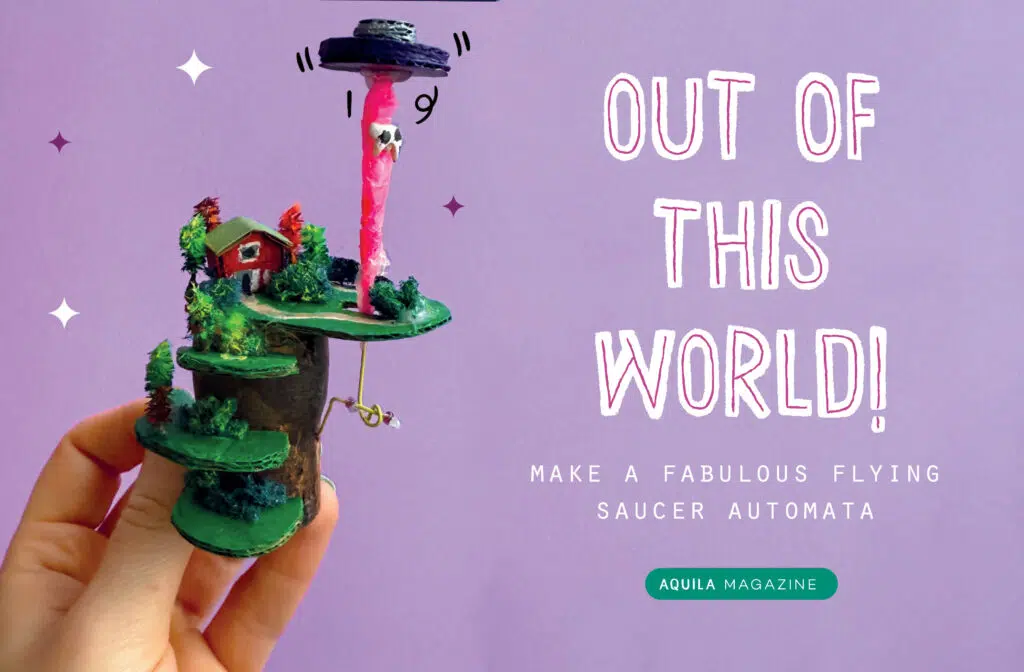
Flying Saucer Automata https://www.youtube.com/shorts/wX7H9WPjQao Words: The AQUILA team. Search Popular Keywords Categories No Record Found View All Results
Read More »