Make popping candy
Make your edible space dust We’re going to make our own version of space dust! Whaaaaat?! Surely you need a

Rocks shape our world, underlying our landscape to form mountains, cliffs, river valleys, beaches and quarries. We sometimes forget they also provide the raw materials for our buildings, even our cars. Join AQUILA on an investigation of the rocks around you – you don’t have to go far. Follow the rules and you’ll soon have a fascinating rock collection of your own.
Set off on your trail by looking at local buildings. Many of these are made from clay bricks. Clay is a very fine-grained rock, which is soft and pliable when wet. When baked, it becomes hard. Find other things made of clay, such as flowerpots, and look up – are the tiles on houses around you made from clay? If not, they may be made from…
Which strangely enough may once have been clay, but has been changed completely by intense heat and pressure (Slate is a metamorphic rock. It is ideal for tiling and flagstones as it splits easily into thin sheets. You will probably see it in areas such as Scotland and Wales where it is more plentiful than clay.
Local building materials will give you a clue to what rocks you might find in the surrounding area. Granite and similar rocks are the most common rocks on Earth, but in the UK they are mostly found in the west and north where they started out as lava from volcanoes.
Look closely at granite and you will see all the different coloured minerals. Aberdeen is known as the Silver City because the main building stone is a granite which sparkles in the sunlight.
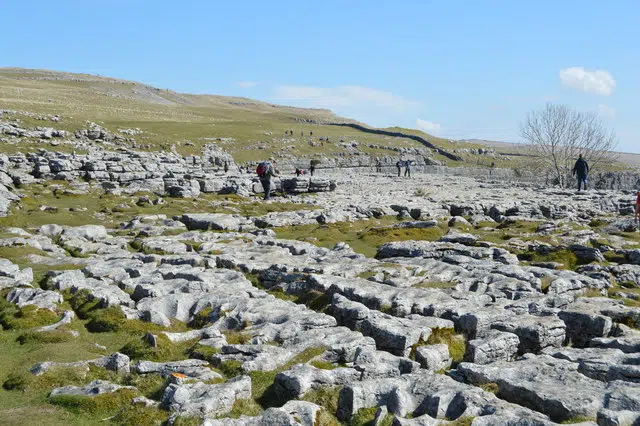
These are sedimentary rocks, made from layers and layers of broken down rocks. You may be lucky enough to live near cliffs that show these layers (called strata), or have these stones in your rockery. Old public buildings such as churches and town halls are often built from limestone or sandstone. Look closely at the surface. If the stone has begun to weather badly, it is likely to be a sedimentary rock which over time dissolves in water.
You may see this in shops, banks or in your own home. It varies in colour from pure white to a mixture of reds, greens and browns. The name comes from a Greek word meaning to sparkle, but if you do pick up a sparkling stone on a walk on the beach, it is more likely to contain…
One of the most common minerals, forming 12 per cent of the Earth’s crust, quartz is found in many rocks all over the world. It comes in many colours – you may see jewellery with a purple amethyst or brown Cairngorm Stone (from Scotland) which are both varieties of quartz.
Another sparkling mineral, pyrite is often called Fool’s Gold as it forms brassy yellow crystals in rocks. You can sometimes find small stone balls which are much heavier than other pebbles on the beach – these are pyrite nodules.
Have you seen a cameo on jewellery, or in a museum? In a cameo, the top layer of a gemstone is carved to reveal the lower one a different colour) as a background. The Greeks and Romans were fond of cameos – you may see ones made from agate or bloodstone.
FOSSILS
These are either the remains of, or impressions made by, former plants or animals. It’s very exciting to discover them, as they are the snapshots of the world’s natural history. Scientists who study fossils (palaeontologists) can date rocks, as certain fossils are found in particular layers of rocks. You can do the same by checking in reference books. In the Middle Ages, people believed supernatural forces created these strange-looking rocks and gave them names like ‘devil’s toenails’ and ‘dragon’s teeth’.
Think of rocks as the building blocks of the earth’s crust. Minerals are in turn the building blocks of these rocks.
You don’t need to collect samples to learn about rocks. Use your eyes when out and you will see rocks everywhere! If you want to make your own collection, follow these rules:
– Notebook and pencil. You can’t really learn about a rock unless you note where it comes from.
– Bags for specimens. If you don’t have any, wrap the specimen carefully in tissue or paper to avoid chipping.
– Labels for bags.
– Magnifying glass. Hold the glass to your eye, and bring the specimen up to it.
– If you are really keen, you can buy special equipment such as:
The streak test is one way geologists have of identifying minerals. Try it yourself. Scrape the mineral across the rough side of a spare wall tile. This gives the true colour of a mineral when powdered, which may be quite different from the colour of the crystal.
For example, pyrite is brass coloured, but its streak is black.
The Geologists Association publishes guidebooks and maps. Rockwatch at the Geologists’ Association is a club for young geologists https://www.rockwatch.org.uk/aboutus/
If you’ve enjoyed this blog and want to read more about geology and fascinating facts, then why not get a subscription to AQUILA magazine!
Words: AQUILA TEAM

Make your edible space dust We’re going to make our own version of space dust! Whaaaaat?! Surely you need a

Can We Really Live on Mars? The Science of Terraforming What are we going to do when we have finished

Alien Brains When you imagine an alien, what do you see? Do you see a little green person with big

Flying Saucer Automata https://www.youtube.com/shorts/wX7H9WPjQao Words: The AQUILA team. Search Popular Keywords Categories No Record Found View All Results

Greek Myths Explained: Heroes, Monsters and Gods of Ancient Greece Heroes Many Greek myths featured a hero – that is,
Make an excellent eight-page zine A zine is a self-published print work, comic or book, produced in very small numbers.