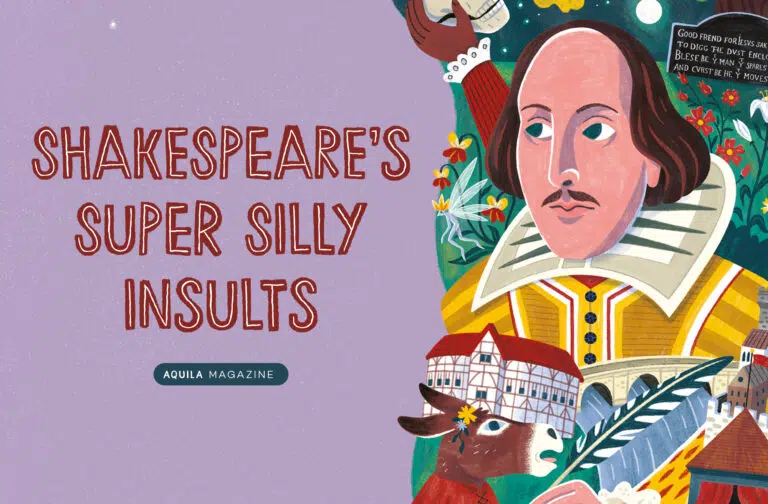
Throwing shade – Shakespearean style

You’ve heard of William Shakespeare. You know what he looked like* and may well have studied at least one of his plays at school. Chances are you may also have formed a judgement about the kind of language Shakespeare used in his plays. Old fashioned? Hard to understand? Get ready to think again.

* Well, you know what people THINK he looked like as most portraits were painted of him after he died.

There is a lot more to Shakespeare’s plays than ‘thee’, ‘thy’ and ‘thou’. Examine his works more closely and you will quickly notice how often his characters say things that are really very rude indeed. Many use bad language and enjoy insulting each other with the kind of zinging one-liners that wouldn’t be out of place in a playground argument. 

Shakespeare loved to include a bit of banter in his dialogue. Name-calling is never a nice thing to be on the receiving end of ­– we certainly wouldn’t encourage anyone to use these in real life – but it can be great fun in the context of theatre. These make up just a tiny fraction of the hilarious insults used by Shakespeare’s characters:

‘Snail’

‘Slug’

‘Sprat’

‘Louse’

‘Red-tailed bumble-bee’

‘Foolish gnat’

‘Baggage’

‘Quintessence of dust’

‘Weak and writhled shrimp’

‘Pernicious bloodsucker of sleeping man’

‘Odiferous stench’

‘Most toad-spotted traitor’

Effective, and so much more inventive than the trash talk we fling around!

http://www.metmuseum.org/art/collection/search/708317

Shakespeare’s insults are usually carefully crafted to suit the play in question. So, in the tragedies, such as Othello or Macbeth, where villains plot and heroes fall, the insults can be pretty savage and unsurprisingly they often include the word ‘villain’, with a variety of adjectives attached to it.

In Romeo and Juliet a wounded Mercutio turns his anger upon Romeo, who has intercepted his fight with Tybalt. He is furious that Tybalt has managed to wound him so gravely.

‘Zounds, a dog, a rat, a mouse, a cat, to scratch a man to death! A braggart, a rogue, a villain, that fights by the book of arithmetic.’

Comic Clashes in the Histories

In the histories, such as Henry IV parts one and two, or Henry V, the insults are usually thrown about between the more vulgar characters, achieving a comic effect.

In Henry VI (part two), Act 1, Scene 3, The Duke of York refers to his accuser as, ‘Base dunghill villain and mechanical’.

Shakespeare uses the word mechanical to mean ‘an unskilled worker’. A dunghill is a pile of… well, I am sure you can work it out, so he’s saying that his adversary is the lowest of the low.

In the comedies, such as Much Ado About Nothing, insults can form an important part of the play. In Much Ado, Beatrice and Benedick appear to dislike each other, having gone out together in the past and broken up. They fall in love again as the play goes on. At the start, when they are insulting each other, Beatrice says to Benedick, ‘Scratching could not make worse, if ’twere such a face as yours.’ She’s saying he is so ugly that she wouldn’t make much impact if she were to scratch his face. He replies ‘I would my horse had the speed of your tongue’. That sounds a bit like a compliment to us, but in those days a sharp tongue and a quick wit were not thought of as suitable attributes for a lady. Oh yes, some of Shakespeare’s most scathing and unpleasant insults are directed at women.

When reading Shakespeare’s plays or watching them, look out for insults in their many forms. You’ll find many a great deal ruder than the ones contained here, you ‘mad mustachio purple-hued maltworms!’

Taking it further: Create your own Shakespearean insults 

Have a go at throwing your own Shakespearean shade! You can either use the formula: pronoun + adjective + adjective + noun or you can use the Shakespeare Insult Kit online at:

http://pangloss.com/seidel/shake_rule.html which will give you plenty of perfectly charming options to choose from.

If you’ve enjoyed this blog and want to read more about xxxxxxxxxxx and fascinating facts, then why not get a subscription to AQUILA magazine

Words: The AQUILA team. Illustration: Kaley McKean

Flying Saucer Automata

Flying Saucer Automata https://www.youtube.com/shorts/wX7H9WPjQao Words: The AQUILA team. Search Popular Keywords Categories No Record Found View All Results
Read More »