BAH, HUMBUG!

“Step away from that mince pie and put your hands where I can see them! You have the right to remain silent…” 

From time to time a story crops up claiming that there is a long-forgotten law still in effect, which makes it illegal to eat mince pies at Christmas. Rest easy. It’s not true! But why would anyone (even some historians) think that such a strange law might exist? Could it be because the lovely, crumbly pastry can cause a criminal amount of mess, no matter how careful you are? (No, that’s almost definitely not it, ed.)

The answer goes back to the days of Oliver Crumbwell – sorry, Cromwell. Oliver Cromwell and the Puritans might sound like the name of a cheesy pop group, but it’s even worse than that. It was they who tried to ban, not just mince pies and all the other lovely grub, but the celebration of Christmas itself!

In the mid-1600s, England went to war with itself, which was a very tricky situation. (If you’ve ever tried fighting with yourself, you’ll know how difficult – not to mention silly – it can be. Especially if you lose.) The argument was to do with the way the country should be ruled, and how much power the king should have, as opposed to Parliament. There was also a religious element to the row. Some on the Parliamentary side were Puritans – a type of Protestant Christian – who suspected that many Royalists were Catholics, a different type of Christianity they feared and hated. Worse still for Christmas festivities (not to mention the king, who lost his head), the Parliamentarians and their Puritans won the war.

A Painting of Oliver Cromwell by Samuel Cooper. Samuel Cooper, Public domain, via Wikimedia Commons

The Royalists never recovered after losing the Battle of Naseby, and one fed-up songwriter came up with some lyrics containing the line: ‘To conclude, I’ll tell you news that’s right, Christmas was killed at Naseby fight.’

And indeed it was… almost. A Puritan was a particular type of Christian who didn’t like all the fancy stuff that went with the religion: ceremonies, music, art and so on. They didn’t think it had anything to do with what was taught in the Bible, and decided it all needed to be thrown out so that Christianity could be made pure.

And of course, nothing summed up all that jollity and frivolity better than Christmas. The song about the Twelve Days of Christmas stems back to how long the holiday lasted. People back then worked very long and hard hours, mostly on the land and in all weathers. You couldn’t just take a couple of weeks off to go to the seaside! Christmas was one of the few times when hard-working ordinary folk could relax and have a good time.

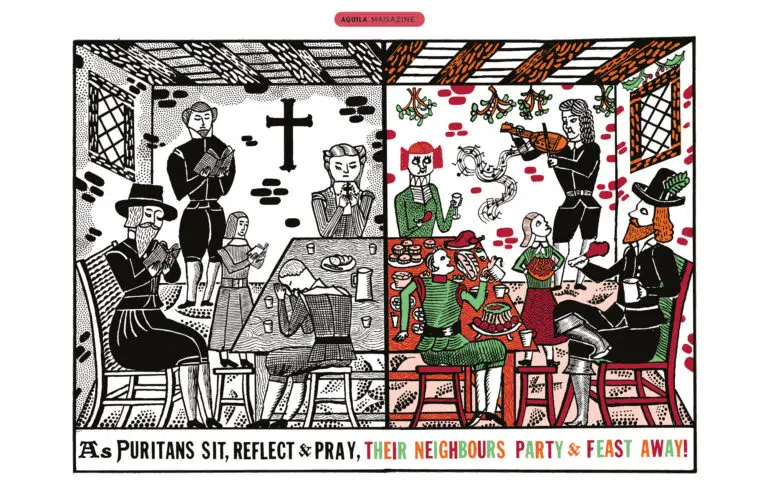
The Puritans hated this. Drinking lots of wine and beer, playing games and scoffing mince pies and Christmas pudding had nothing to do with the birth of Jesus. Surely, if it were to be a Holy Day (which is where we get ‘holiday’ from) it should be spent in prayer and quiet reflection. But on top of that, the Bible never actually said that Jesus was born on 25 December – nobody really knows when he was born. For that reason, some Puritans insisted on going to work as if it were any other day.

Illustration: John Broadley

So although mince pies specifically weren’t made illegal, the government did try to outlaw feasting and celebrating at Christmas, and insisted that shops and businesses stayed open.

But it didn’t go down too well. Perhaps unsurprisingly, the Puritan war on Christmas became unpopular, even with many who had supported the Parliamentary side. It led to pitched battles in the streets of London, the Plum Pudding Riots in Canterbury and the terrible Manchester Mistletoe Mayhem. (Okay, I made that one up, but the others are genuine and really there was a lot of rioting.)

Luckily for mince pie fans, the people got fed up with the way the country was being run. King Charles II (who enjoyed a good time as much as anyone) was brought back from exile abroad, and things gradually returned to normal.*

* (… if you discount the Great Plague, the Great Fire of London and the incredibly floppy hair, then yes, sure. Normal. Ed).

Tabletop Still Life with Mince Pie and Basket of Grapes. Pieter Claesz, Public domain, via Wikimedia Commons

An Xmas miscellany

  • Why is it sometimes written as Xmas? The letter X is a Greek abbreviation for Christ.
  • In the song ‘The Twelve Days of Christmas’, most people get day four wrong. It’s usually sung as ‘Four Calling Birds’, when in fact it should be ‘Four Colly birds’. Colly is an Old English name for blackbirds, meaning something like ‘as black as coal’.
  • In Serbia, children tie up their parents. (Don’t try this at home, unless it’s part of your tradition, and you know what you’re doing, ed.)
  • In Italy, a good witch delivers presents on a broomstick on 6 January.
  • In Greenland, a traditional wintertime food consists of a decomposing bird wrapped in seal skin and buried under a stone for several months. It’s called kiviak. (Don’t try this at home, unless it’s part of… etc, ed.)
  • In Iceland, puffin and roasted reindeer are on the menu!

If you’ve enjoyed this blog and want to read more fascinating facts, then why not get a subscription to AQUILA magazine! CAN WE SAY SOMETHING ABOUT THE LINK TO ACTIVITY SHEET?

Words: Joanne Owen. Illustration: Liv Bargman. With thanks to Dr Althea-Maria Rivas

Flying Saucer Automata

Flying Saucer Automata https://www.youtube.com/shorts/wX7H9WPjQao Words: The AQUILA team. Search Popular Keywords Categories No Record Found View All Results
Read More »