Brain Box: Brilliant Women and Their Mind-Bending Brainteasers

At the end of last year, Dr. Apostolos Georgopoulos, the director of the Brain Science Centre at Minneapolis VA Medical Centre in the USA, reported that research he had carried out found that in many different tasks, women processed information about five times faster than men. Furthermore, he said, they were also more efficient as they used less of their brain to carry out identical cognitive performances.

Well, we all knew that didn’t we? A quick look at the history books reveals some of the top female brains down the ages, and four of them featured below have set you each a tricky problem. Can you solve them?

Hypatia

Hypatia studied and taught at the famous school/library in Alexandria, often regarded as the ‘brain factory’ of the ancient world. Although it was in Egypt, it was really run by the Greeks. Famous names that worked there included Eratosthenes, Euclid, Diophantus, Archimedes and Hypatia’s father, Theon.

Legend says that Hypatia, who lived around 400 CE, was so beautiful that she had to give her lessons from behind a screen so students would not be distracted from their studies. As well as teaching at the school, Hypatia also tutored the children of wealthy people and many students from other cities travelled to Alexandria to study and learn from her. She spent some time writing commentaries on the work of other mathematicians like Diophantus and Apollonius; the latter wrote a book called Conics about cutting sections through a cone.

Unfortunately, Hypatia’s life ended in tragedy in 415 CE during a dispute between the school’s staff and local Christians who believed students were being taught pagan ideas. Hypatia was forced from the street into a local building and killed. Afterwards students began to drift away from Alexandria and the school declined. The work Hypatia had done, though, was preserved.

LEVEL UP

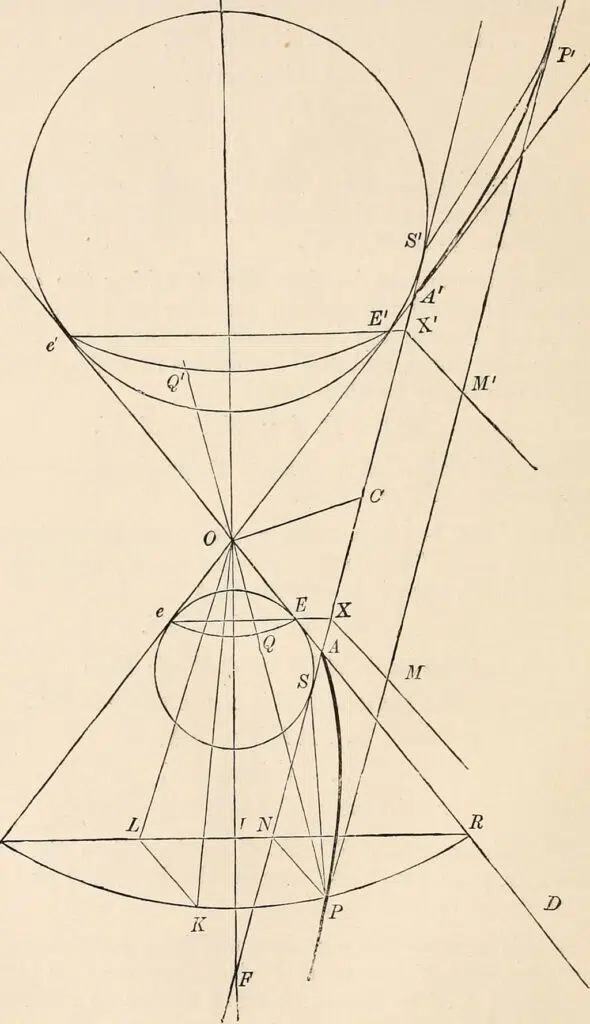
Hypatia’s Brainteaser: Remind yourself about all the main words connected with a circle, like radius, arc, quadrant etc. and show examples of them. Then investigate these lesser-known shapes with curved lines which are connected to a cone – ellipse, parabola and hyperbola.

A geometrical treatise on conic sections, with numerous examples. Internet Archive Book Images, No restrictions, via Wikimedia Commons

Sophie Germain

Sophie Germain’s parents were so frightened of her going out into the streets of Paris during the French Revolution (1789 –1799) that they confined her to the house. She became so bored that she spent most of her time in the library learning about famous mathematicians and scientists, especially Archimedes.

When she was 18, an important school, the Ecole Polytechnique, was founded in Paris to train mathematicians and scientists, but women were not allowed to enrol. Through friends she managed to obtain lecture notes from the courses, especially classes run by one tutor, Joseph-Louis Legrange. She wrote to him using a false man’s name (Monsieur LeBlanc) and submitted some of her work. He soon spotted her talent and, even when he later found out she was a woman, became her mentor.

During 1804, Sophie also began to correspond with the eminent German mathematician Carl Friedrich Gauss, and she sent him some of the results of her work on number theory. During her investigations, she found what is now known as Sophie Primes.

Her mathematical investigations made major contributions to the theory of acoustics (sound) and elasticity (the ability of a material to resume a normal shape after being stretched or squeezed). Sophie later attended meetings of both the Academie des Sciences in Paris and the Institut de France. She died in 1831 at the age of fifty-five.

LEVEL UP

Sophie’s Brainteaser: Starting from 2, list all the numbers up to 50 that are prime numbers. Then using the formula, find which ones are Sophie Germain primes. My formula is 2 x p (prime) + 1 = prime number.

Take 7, for example, so 7 x 2 + 1 = 15, but that’s not a prime number. But take 11, so 11 x 2 + 1 = 23 and that is a prime number. Eleven is a Sophie Germain prime.

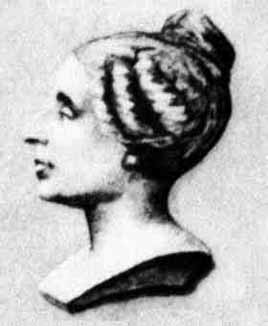
Portrait of Sophie Germain (April 1, 1776 - June 27, 1831) via Wiki Commons

Ada Lovelace

Ada Lovelace was the daughter of the famous romantic poet Lord Byron but her father left the country several months after she was born and she was never to meet him. Lord Byron died in Greece in 1823.

Ada’s mother encouraged her daughter to concentrate on maths and science and spent some time teaching her at home. At the age of eight Ada was able to solve quite difficult mathematical problems and soon afterwards drew out the plans for a flying machine.

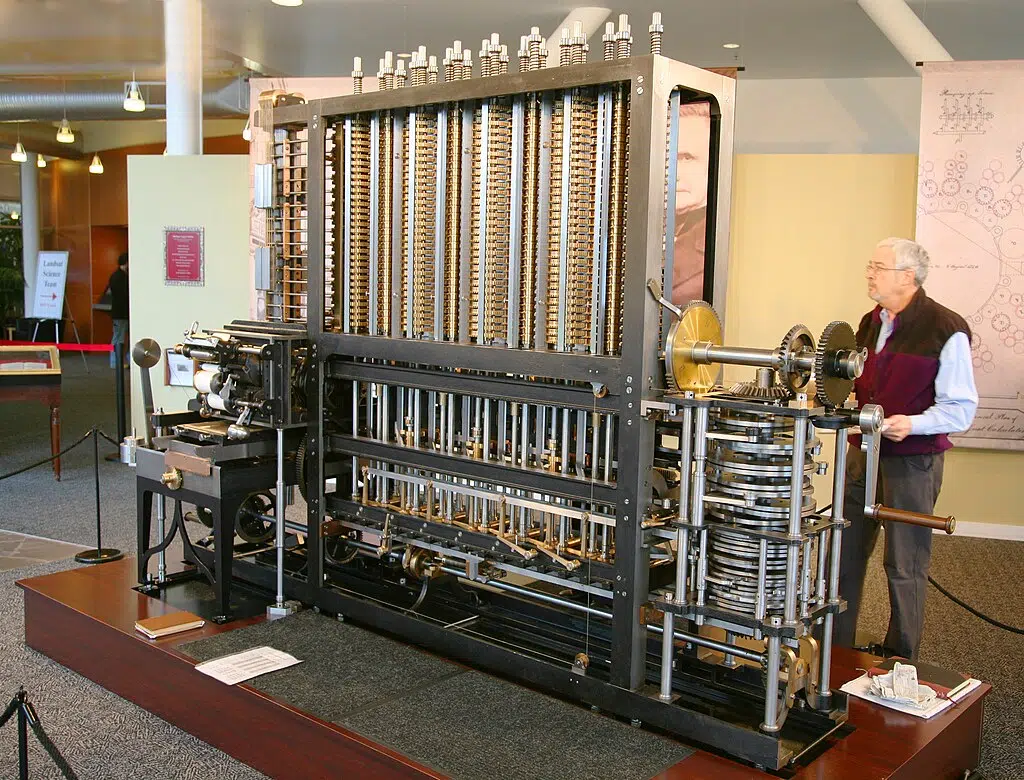
At the age of 17 Ada was introduced to Charles Babbage, who was a professor of mathematics at Cambridge University. He was working on a huge contraption called a difference engine which stood over two metres high and is said to have contained 25,000 different parts. It was basically a complicated calculating machine that Babbage was looking to improve. Later, with Ada’s help, he went on to work on his analytical engine which could not only calculate but also store information in a memory and make decisions. Babbage exchanged ideas with foreign scientists including Luigi Menebrea but because he could not speak the language, Ada translated the notes for him. She was also able to add her own observations and ideas and became a key member of the whole project.

Ada, who later became Countess Lovelace when her husband inherited a title, was quick to see the potential in such machines, predicting that they might go on to compose music, provide graphics and help with science experiments. Later, when she fed her own information into the machine, she effectively became the world’s first computer programmer. Ada, often referred to as the ‘enchantress of numbers’ died in 1852. She was only 36 years old.

LEVEL UP

Ada’s Brainteaser: Computers today use the binary code to send information. It only uses the digits 0 and 1. Binary is known as base two; each move to the left increases the number by the power of two e.g. 32, 16, 8, 4, 2, 1. So 13 in binary would be 1101 (8+4+0+1) and 111 would be the number 7 (4+2+1). Put these numbers into the binary system: 6, 14, 23, 30. Convert these binary numbers into base ten: 101, 1001, 1111, 100110.

A replica of a very early computer based on the Charles Babbage and Ada Lovelace Difference Machine. A version of this machine can be seen in the Science Museum in London. Jitze Couperus from Los Altos Hills, California, USA via Wiki Commons

Shakuntala Devi

Shakuntala Devi had such a nimble mathematical brain that she was able to carry out complicated mental arithmetic calculations quicker than state-of-the-art computers.

Even at the age of three she could solve the problems posed by the card tricks of her father who was a magician. She did not do it by sleight of hand or by pre-arranging the deck though, but mastered the skill of memorising the position of all of the 52 cards. In 1982, the Guinness Book of Records titled her as ‘the world’s fastest human computer’ when she correctly multiplied two 13-digit numbers together in just 28 seconds. These numbers, 7,686,369,777,870 and 2,465,099,745,779 were randomly chosen by the Computer Department of Imperial College, London. If you want to try it yourself the answer is a staggering: 18,947,668,177,995,426,462,773,730.

Shakuntala Devi, who was also well known as an astrologer, visited many places while on tour always encouraging children to enjoy mathematics, and gave particular advice on how to add numbers mentally. She wrote a number of books during her career including Figuring: The Joy of Numbers (1977) and Awaken the Genius in Your Child (1999). She said, “The purpose of my life is to make everybody, especially children, enjoy maths as an affable and joyful experience.” She died in her native India in 2013 at the age of 83.

LEVEL UP

Shakuntala’s Brainteaser: Here’s a little number puzzle you can play in pairs. It always seems to work but can you explain why? One of you should think of a number and write it down. Tell them to add 7 to the number, multiply by 2 and subtract 4. They should tell you the answer. If you divide the final number they have by 2 and subtract 5 it should produce the number they started with in the first place. Example: Number chosen 24 + 7 = 31 x 2 = 62 – 4 = 58. Then 58 ÷ 2 = 29 – 5 = 24.

Shakuntala Devi, 16 September 1968 via Wiki Commons

Solutions

Sophie’s Brainteaser: The prime numbers between 1 and 50 are 2, 3, 5, 7, 11, 13, 17, 19, 23, 29, 31, 37, 41, 43, 47. Of these, 2, 3, 5, 11, 23, 29, 41 are Sophie Primes.

Ada’s Brainteaser: 6 (110), 14 (1110), 23 (10111), 30 (11110); 101 (5), 1001 (9), 1111 (15), 100110 (38).

If you’ve enjoyed this brainy blog then why not sign up to a subscription to AQUILA magazine! 

Written by John Davis. Illustration by Nolan Pelletier

Flying Saucer Automata

Flying Saucer Automata https://www.youtube.com/shorts/wX7H9WPjQao Words: The AQUILA team. Search Popular Keywords Categories No Record Found View All Results

Read More »