The Art of Make Do and Mend: WWII Sewing Tips to Revive Old Jeans

World War II put huge pressure on the clothes manufacturing industry. New garments were very hard to come by because there simply were not the materials or the labour needed to produce clothing on the scale we know today. 

During World War II, if you ripped your trousers, or grew out of your warmest jumper, you needed to know how to make do and mend. Men, women, boys and girls all learned how to knit and sew. Children knitted woolly hats and socks for troops and refugees. Servicemen and POWs used needlecraft as a way to keep calm and carry on. 

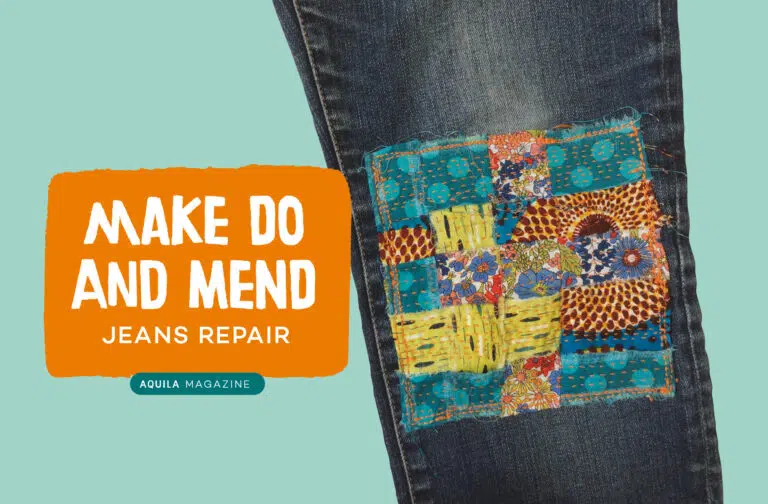
Today most people have access to many more new things, but that doesn’t mean we shouldn’t learn how to look after old things. This project is a great way to breathe new life into your favourite pair of tattered jeans, AND it keeps clothing out of landfill. Make do and mend is GREAT for the environment.

You will need

● A pair of ripped jeans 

●  A ruler,  pen and paper

● Strips of fabric, scraps will do

● Needle, thread and scissors

Step 1

Lay your jeans out on a flat surface and measure the area you’d like to patch. The patch needs to be bigger than the hole you are patching. We’ve decided that our patch will be a square roughly 12 cm x 12 cm.

Step 2

Write your measurements down. You might like to draw a square with your measurements. Although this isn’t strictly necessary it is useful for checking that your patch will cover the hole you’re patching.

Step 3

Cut or tear scraps of fabric into long strips. They don’t have to be the same width or the same colour, in fact the more variety you start with, the more interesting your patch will look.

Remember: All woven fabrics are made up of a warp, which runs lengthwise down the fabric, and a weft, which runs across the width of the fabric. The weft is drawn over and under the warp to form cloth. 

Step 4

Choose some strips (however many you need) to form the warp and lay them on a flat surface. 

Tip: If you’re into Minecraft, why not try using brown and green coloured strips to make a pixelated patch?

Step 5

Choose some more strips to form the weft.

Step 6

One-by-one, thread them over and under the warp strips. If the line above begins with the weft going over the warp, the next line should begin with the weft going under the warp. See below.

Step 7

When you are happy with your arrangement, pin all the strips in place.

Step 8

Use a running stitch to sew all the strips in place. I’ve covered the whole area in lines of running stitch set about 5 mm apart. It’s a great way to practise your sewing.

Step 9

Take all the straggly ends of your strips and fold them over to neaten the edges. Sew in place.

Step 10

Pin your finished patch onto your jeans, covering the hole. Pin and sew in place. I used backstitch for extra strength but if you don’t feel confident with that, running stitch will be just fine.

Voilà, now your jeans are completely unique AND all in one piece!

If you enjoyed this fun make, then why not think about a subscription to AQUILA magazine! 

Written by the AQUILA team

Flying Saucer Automata

Flying Saucer Automata https://www.youtube.com/shorts/wX7H9WPjQao Words: The AQUILA team. Search Popular Keywords Categories No Record Found View All Results

Read More »